
Leaders are Made
“When we humbly recognize and name our limitations, we take our first step toward transforming them into our greatest opportunities for growth.”
September 9, 2019
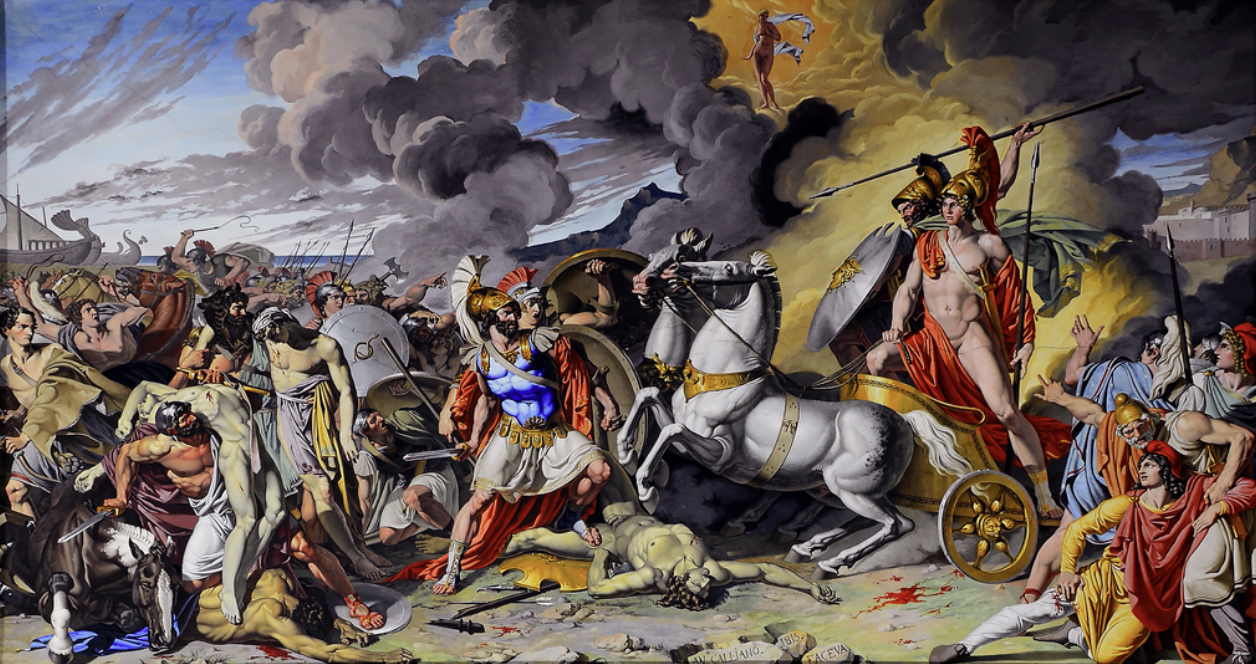
The Iliad tells the story of two warriors, Achilles and Hector. One warrior was born a demigod (Achilles) and the other fully human (Hector). Achilles' mother Thetis, determined to make her son even more impenetrable, dipped the young Achilles in the River Styx, a river whose mystical water would protect him from harm and death. As Thetis dipped her son into the river, she was able to cover/protect every part of the boy, except his ankle. His only weakness was his heel (hence the phrase, "Achilles Heel"). It wasn’t just Achilles heel that was his weakness, but his ego, petulance, vain glory and desire for vengeance. Even with these flaws, Achilles was still the most capable warrior alive. He was born gifted!
In contrast, every square inch of Hector was susceptible to harm. He didn't have a goddess mother and wasn't born with divine abilities. He was like us, human! Hector was a loving and loyal son, husband and father and citizen soldier who only fought to protect his family and his country. He was Troy's best warrior and a model for all of us born from the dust. His effectiveness as a warrior wasn't given to him at birth; it was something he had to learn and earn through experience.
As a mortal, Hector had to learn how to hone his skills as a warrior and leader. On the eve of his battle with Achilles, he had a conversation with his wife, Andromache, who pleaded with him to not go back into battle the next day, fearing he would die. He expressed to Andromache his own limitations and feelings of mortality, but nevertheless, why he must step into battle.
"All this weighs on my mind too, dear woman. But I would die of shame to face the men of Troy and the Trojan women trailing their long robes if I would shrink from battle now, a coward. Nor does the spirit urge me on that way. I’ve learned it all too well. To stand up bravely, always to fight in the front ranks of Trojan soldiers, winning my father great glory, glory for myself" (Iliad Book VII, 6.63-70).
Like Hector, we are susceptible to the human limitations of fear and shame. These human emotions can sometimes entice us to stay home where it is safer and more predictable. But, these emotions can become opportunities to practice standing up during difficult situations. Sadly, Hector met his fate on the battlefield fighting Achilles, but he left us a lasting legacy of a hero who was made, not born.
When we humbly recognize and name our limitations, we take our first step toward transforming them into our greatest opportunities for growth. Sometimes we walk into leadership situations where we feel unqualified and mismatched. Anyone? It is often in these situations that we learn and are strengthened the most.
Most of us will never be the stuff of legends. Instead, we are leaders who carry around real human emotions and limitations. We need to recognize that if we are going to make our lives mean something, we will need to embrace the characteristics of our humanity and stop trying to convince ourselves that we are impervious to the dangers of this world. True bravery in leadership is stepping into situations where we don't know the outcome, but we decide to engage anyway because our integrity and others lives depend on it.
Questions in which to marinate:
What is the most difficult task to which to have been called as a leader? How has learning from your past helped prepare you for this task?
As a leader, what have you learned about yourself lately that has provided increased clarity for your current challenge(s)?
What similarities do you see between Hector and the best leaders with whom you have had the opportunity to follow?
What are you most afraid of losing as a leader? How might your fear of losing this thing be undermining your leadership?
5 GeARS
“Throughout our day we need to be aware of when to be in the most appropriate gear for the situation.”
Scott Grabendike
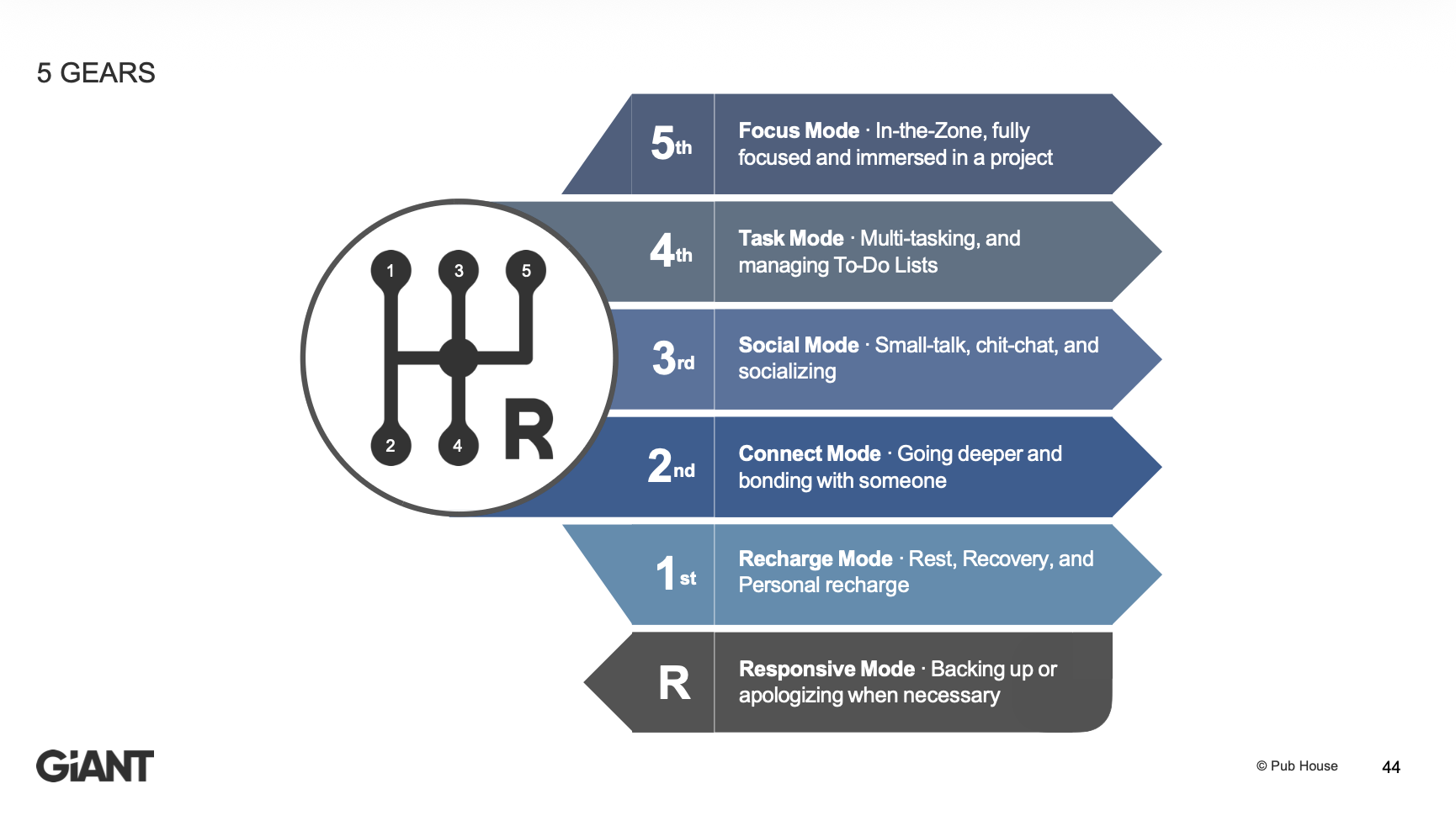
March 3, 2020If you have ever driven a manual transmission you know how involved the driving experience can be. Most Americans are accustomed to driving automatics where we put the car in drive and let the transmission do all of the work for us. If only life was "automatic."When it comes to finding work/life balance we need to be more intentional and involved in the process. Throughout our day we need to be aware of when to be in the most appropriate gear for the situation. Some of us prefer 5th Gear (Focus Mode) where we can hammer out details and get a lot of tasks completed. 5th Gear is necessary to get things done. However, we can easily get stuck in 5th Gear and get consumed with tasks and fail to be present with the people around us. Ultimately, being stuck in 5th Gear erodes trust with our families, teams and organizations.
4th Gear (Task Mode) is where many of us spend the majority of our day. While in 4th Gear we are in and out of conversations, projects, emails, text messages and meetings. We need to be in 4th Gear at different times during the day, but we also need to be aware of how reactionary we can become when we are stuck in this gear. The needs around us will always be greater than our capacity. Without the ability to upshift or downshift out of 4th Gear, we will ultimately find ourselves burned out, and subsequently, no good to anyone.
3rd Gear (Social Mode) for some is seen as a waste of time, especially for those who prefer 5th Gear. While some people can abuse 3rd Gear in the workplace, it is also the most adaptable and necessary gear in an age of collaboration. Team meetings should always start in 3rd Gear! Team members should be invited to put away their electronic devices and be fully present with the others prior and during meetings. Once the meeting starts, the team can shift into 5th Gear with greater ease. Research shows that the highest performing teams are those who create space for 3rd Gear!
2nd Gear (Connect Mode) is experienced when we slow down and enjoy the connection with friends and family outside of work. This is one of the most enjoyable gears and can be the gear that best reminds us that we are more than what we do.
1st Gear (Recharge Mode). For years I would spend most of my day in 3rd and 4th Gear, and by the time I got home, I was so exhausted I would immediately downshift into 1st Gear or what I thought was 1st Gear. My tendency was to escape into a book, Netflix or a hobby, never feeling rested. I have realized over the years that there is a difference between crashing and recharging. Although, 1st Gear will look differently for each of us, we must all be intentional about finding time and space in our day to do something that recharges us.
Don't forget Reverse (Responsive Mode). This gear allows us to back up and apologize when we are in the wrong gear at the wrong time. You may come home from a long, exhausting day and have the tendency to slip right into 1st Gear. If you are single, the shift from Gears 5, 4, and 3 when you get home will seem natural. However, if you have a family, try spending some time in 2nd Gear before you downshift into 1st Gear. And if you fail to match the gears of those around you, back up and ask for forgiveness.
Finally, focus on addressing your weakest gear and you will see significant growth in your life. Ask for permission from the people around you to be in a particular gear depending on your need. Teach others in your life the language of the 5 Gears. Communicate and show deference to them when they need to be in a different gear than you. The more involved and intentional we are in shifting through the gears, the more enjoyable the journey for everyone.
What is your preferred gear?
What is your most difficult gear?
When was the last time you were in the wrong gear with someone? What was the result?
What gear, if you worked on improving this year, would lead to the most significant growth in your life?
Push/Pull
“One of the ways we demonstrate our emotional intelligence is with others is by knowing when to Push and when to Pull.”
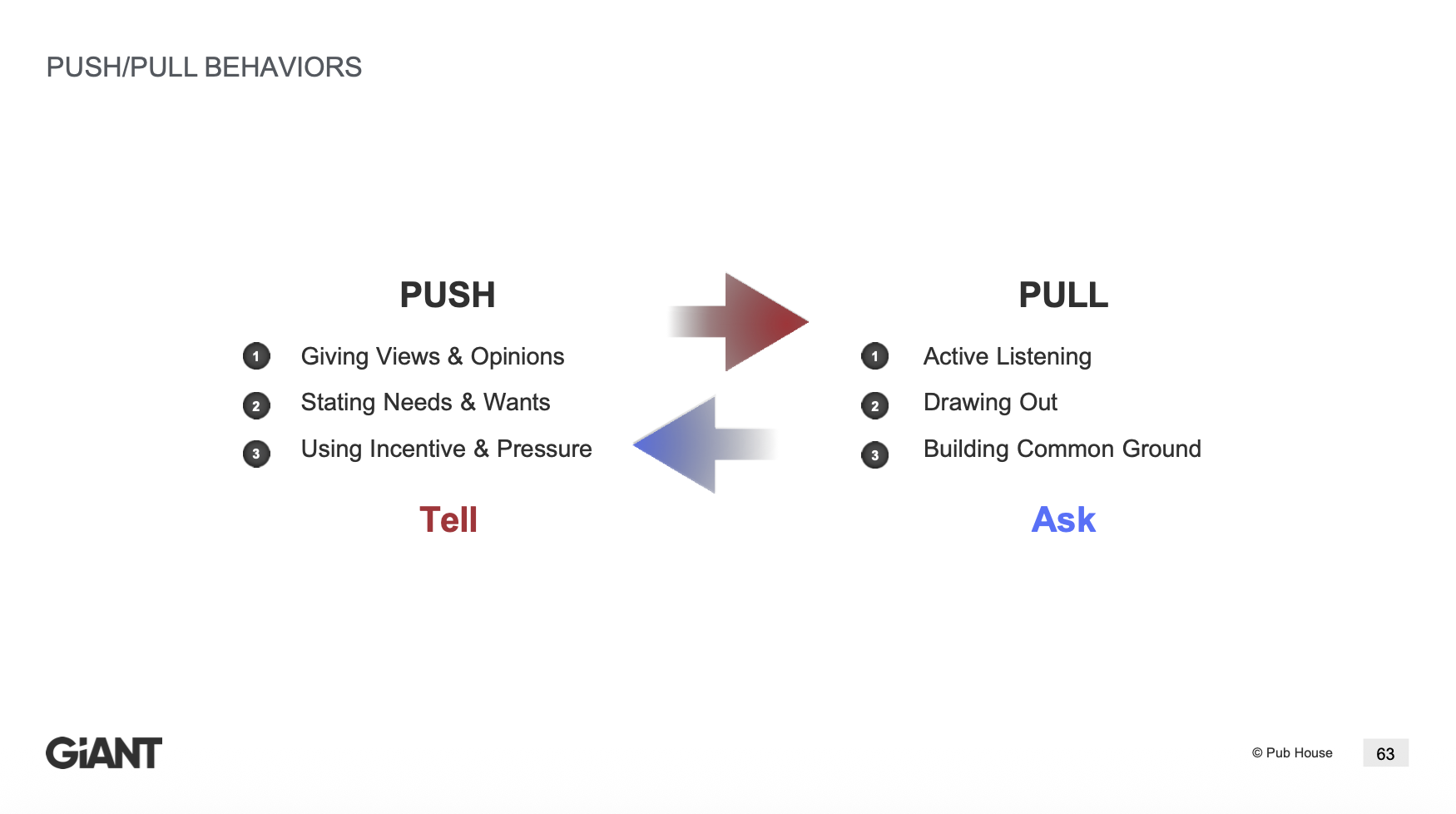
One of the ways we demonstrate our emotional intelligence is with others is by knowing when to Push and when to Pull. We need to to do both, but we might find one more natural than the other.
Years ago, I was leading a team that was apprehensive about sharing their opinions/ideas during our brainstorming sessions. I approached one of the team members individually and asked them why they were so quiet during the meetings. They gave me some valuable feedback. They said, "I don't speak up in our meetings because it feels like you have already made up your mind about what we should do. My opinion doesn't matter." Ouch! What my colleague was sharing with me was that they felt pushed out of, rather than pulled into the conversation.
At the time, I was unaware of how my tendency to push was limiting our team's collective potential. Unfortunately, this tendency resulted in others becoming less excited, and consequently, lowering their volume to complete silence. If we want the people around us to feel heard we need to give them the opportunity to speak first. Letting others speak first will strengthen our influence with our team members. And, when we do need to push, others will be more likely to listen.
THe power Test
“A leader who uses their power for others reveals their intent by empowering, apprenticing and liberating (unleashing) those whom they lead.”
How are you channeling the power and influence you've been given? For some, power is a zero sum game. They believe that if they give power away they lose it and the other gains it. This type of thinking keeps a leader from having true influence in other's lives. Instead of using power for others they use it over others. They overpower, control, manipulate in order to retain and gain power. Eventually, the people they are leading will feel like the leader is only concerned with their own self interest.
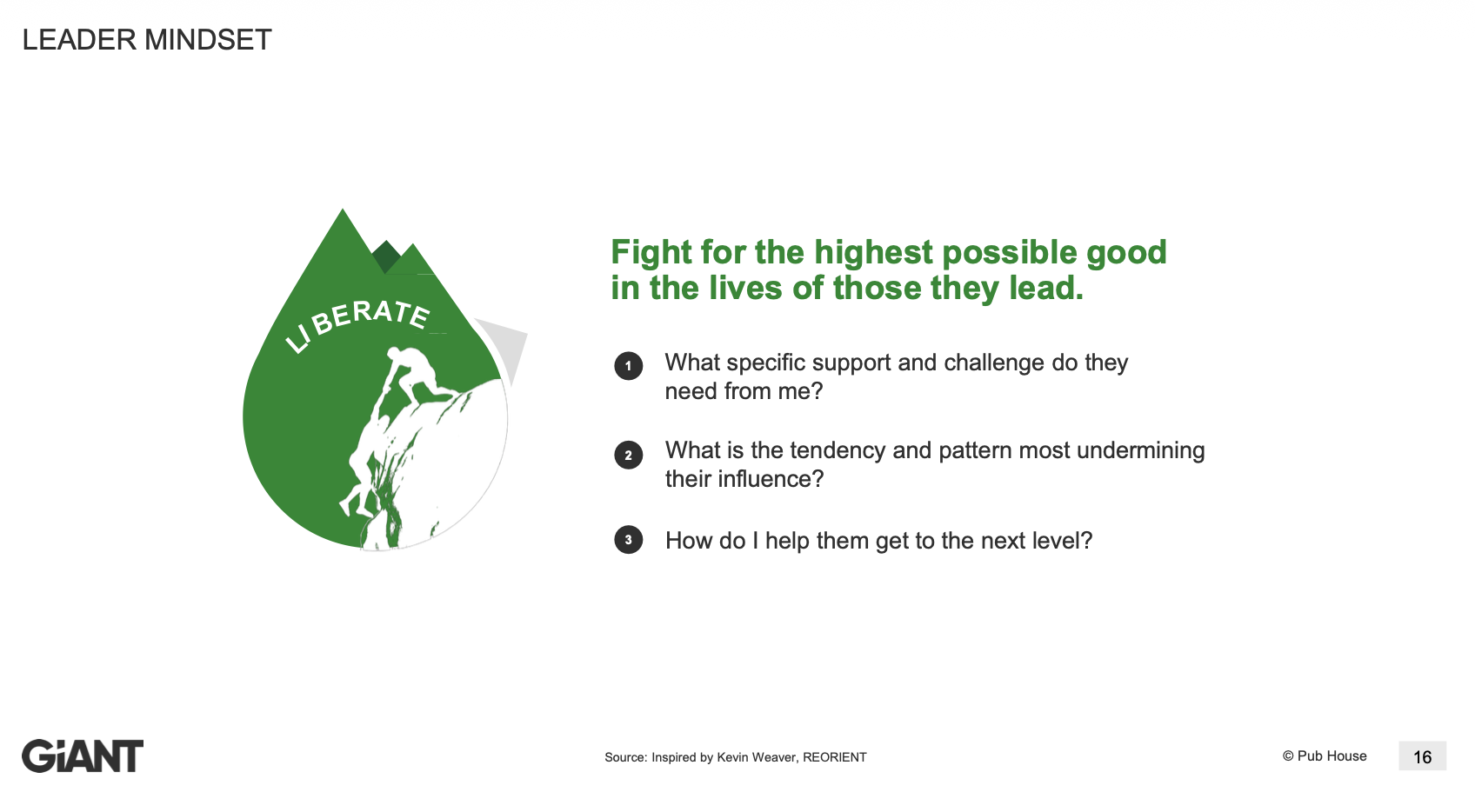
A leader who uses their power for others reveals their intent by empowering, apprenticing and liberating (unleashing) those whom they lead. Their intent is directed outwardly toward others. Their power investment creates growth in the people and teams they lead, which results in their increased influence. As they use their power for others they gain it back through increased influence. Leadership is ultimately about influence!
Are you viewing power as a zero sum game? How have your actions revealed your intent? In what ways might you need to redirect your power to others rather than self?

Peace-Keeping or Peace-Making?
“Engaging in conflict with our teams can feel like walking across a suspension bridge.”
July 1, 2019
If you have ever walked across a suspension bridge you know that the two most stable points of the bridge are on the opposing sides, and the most unstable point is in the middle. It is in the middle where things can get shaky/scary (Red= "Stop"). Engaging in conflict with our teams can feel like walking across a suspension bridge.
When we approach the conflict we might be tempted to return to the perceived safety of where we started rather than pushing through the discomfort of the middle. Our fear of the middle (Conflict) will leave us with a Provisional-Peace (Yellow="Caution") where we will never quite be sure of the stability beneath us. We might wonder if our team is being fully honest with each other or if they are holding back for fear of hurting someone's feelings. This fear might be reinforced when we experience passive-aggressiveness from others.
When we take the first step beyond Provisional-Peace, it will feel like our stability is decreasing. This initial instability will slowly turn into an increased stability. Slowly and steadily we will start increasing our chances of experiencing Genuine-Peace (Green= "Go"). Genuine-Peace differs from Provisional-Peace in that we don't have to wonder if the bottom is going to fall out beneath us. Instead, we will experience the security of standing on solid ground and we can move forward with confidence.
Of course, a basic level of trust must be present before we engage in conflict with our teams. At the same time, we increase trust with each other as we engage in the conflict. The most exceptional leaders are those who are able to share a vision of the necessity and pay off of healthy conflict. These leaders don't just paint a picture for their people; they walk with them across the bridge and help them enjoy the payoff.
When we take that initial step toward conflict it will feel like our stability is decreasing (-), but as we move toward the source of conflict, and beyond, we will experience increased stability (+). From here we will experience new opportunities that we weren't able to see before. Experiencing Genuine-Peace does not mean that we simply move beyond conflict into some kind of conflict-free land. Effective conflict management and resolution is necessary for every team's growth. In order to experience Genuine-Peace we must consistently engage in the necessary and unsettling work of conflict.
Questions to Marinate In:
How has your inability to step into conflict with individuals and teams kept you and your team from opportunities?
What kind of Peace is your team currently standing upon?
What has the Provisional-Peace cost you? How would Genuine-Peace benefit you?